
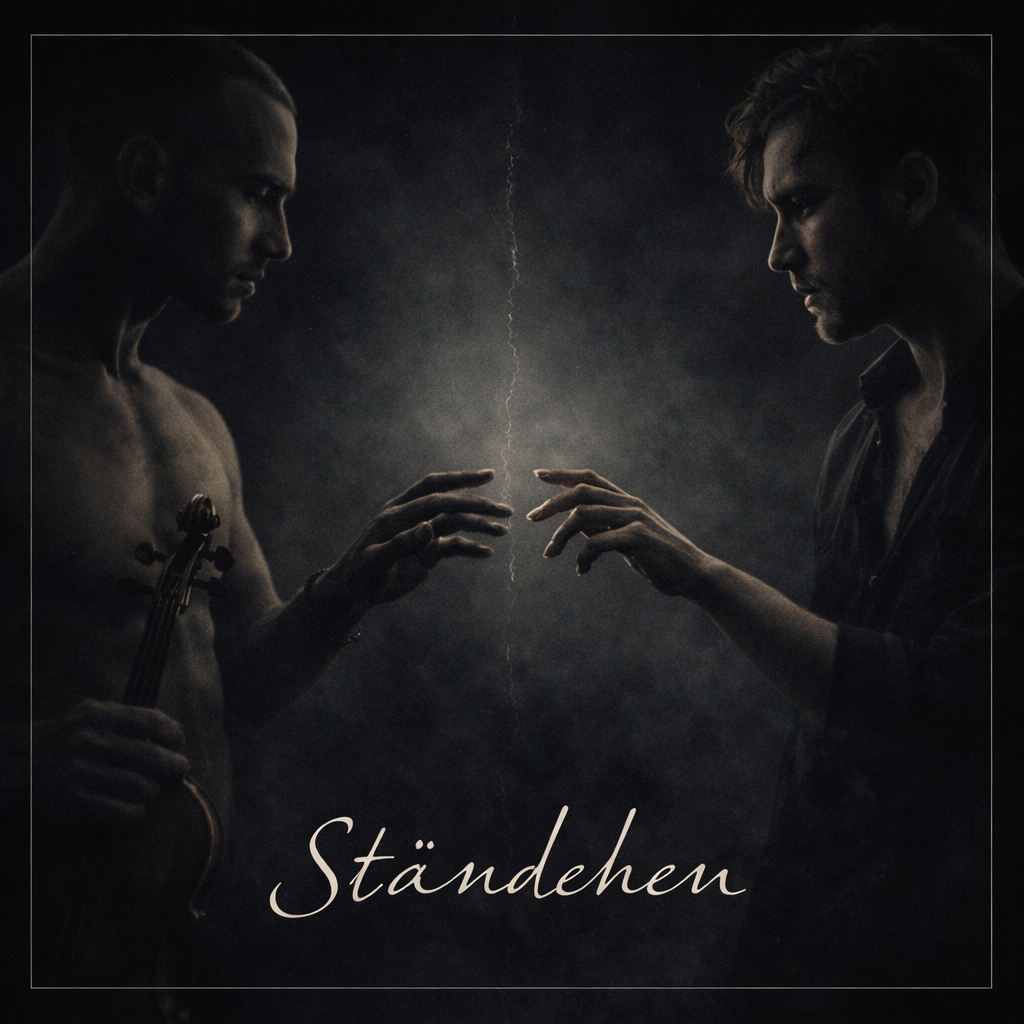
Ständchen
Ständchen exists in UNBOUND as a moment of stillness—but not emptiness. It is intentional, intimate, and deeply personal.
Originally composed by Franz Schubert, this piece has long been associated with longing, vulnerability, and quiet devotion. But the version used in UNBOUND is not traditional. It was reimagined and developed by Marcos alongside Eric Swanson for Eric’s film The Fiddler’s Green. That context matters—because this interpretation was never meant to simply recreate something classical. It was meant to carry emotion, story, and cinematic depth.
That is why it lives here.
Placed at the threshold between Act I and Act II, Ständchen now exists not as a live performance, but as a visual and emotional bridge—underscoring a promotional glimpse into The Fiddler’s Green. The music becomes the foundation beneath the imagery, allowing the story on screen to breathe while still guiding the audience emotionally.
After the weight and intensity of everything that has come before, this moment pulls everything inward. The scale becomes smaller. The energy becomes quieter. But the emotion becomes clearer.
This is where the audience is asked to feel—without distraction.
There is no spectacle here. No live movement commanding attention. Instead, the violin becomes a cinematic voice—fragile, exposed, and honest—woven into the visual narrative unfolding on screen. It does not demand attention; it supports it. And in that support, something shifts.
Emotionally, this moment represents reflection.
It is the space between breaking and becoming. The space where everything that has been felt begins to settle—where the audience has a chance to process what has happened without being pushed forward. The visuals offer context, but the music allows the emotion to land.
There is also something more personal in this placement. Because this arrangement was created through collaboration—between Marcos and Eric—it carries a different kind of connection. It is not just about performance; it is about creation, storytelling, and shared artistic intention. That intimacy remains, even as the format evolves.
Within UNBOUND, Ständchen reminds us that not every moment of transformation is loud.
Some of the most important shifts happen quietly.
In the moments where nothing is being forced.
Where nothing is being proven.
Where you are simply present with what is.
It is not the climax.
It is the pause that makes everything after it possible.
“Les plus grandes vérités sont celles que l’on ressent sans les dire.”
(The greatest truths are the ones felt without being spoken.)
French Proverb